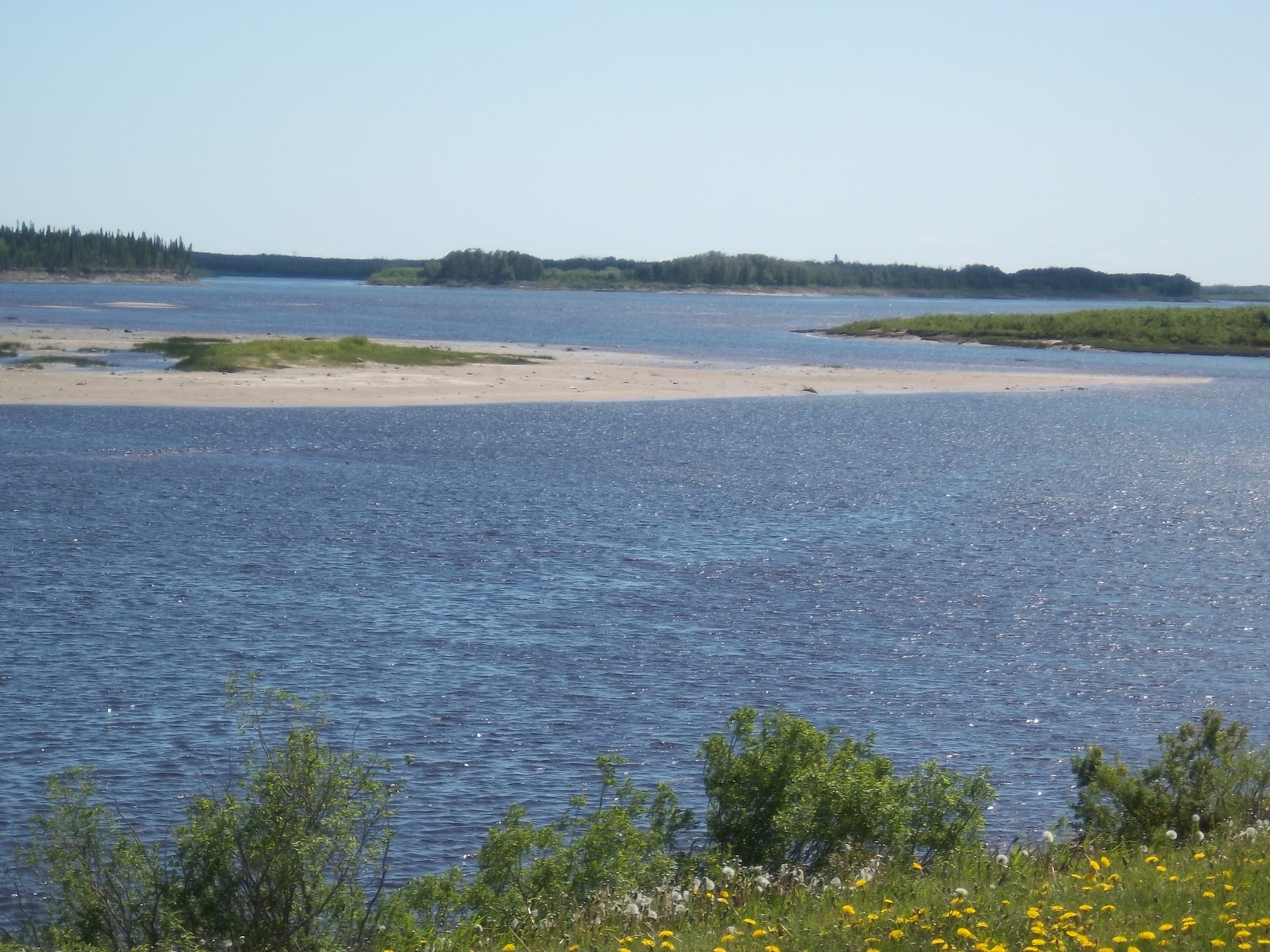
Into the vast forests of Northern Ontario and Quebec - trees as far as the eye can see - dotted with rivers and lakes at every turn in the road. We have only seen 1 young bull moose in velvet and 2 black bears. We had hoped for much more. We have seen 23 species of warblers on breeding grounds including the Connecticut and Black-throated Blue ( 1 each). Our Canada bird list is just over 100 hoping for many more as we keep traveling east. We have camped at Sleeping Giant, Fushimi Lake, and Rene' Brunelli Provincial Parks. In Moonbeam (yes, it is a town with signs of "little green ETs" everywhere, even on the trails where we walked birdwatching for a few kilometers.
At Cochrane, ON, we took the "Polar Bear Express" train 186 miles north to Moosonee, a Cree Indian village full of dusty, dirt roads that go nowhere but the natives were driving everywhere. The only way to this town is by train, boat or air. In winter, polar bears are sometimes seen here but the only one we saw was this one!! Someday we will travel to where we can see them in their native habitat. Canada sure has its share of Black Flies, Mosquitos and Gnats, and we have the itchy lumps to prove it.
Into French Quebec, where it seems no English language is allowed on signs or taught in the schools for hardly anyone can understand English and our French is nil. So far we are winging it, at least the numbers read the same on the highway signs. Things are different shopping too - the "Lait partiellement e'cre'me'" 1% Milk comes in bags ( 3 bags = 4 liters) We are having fun opening and pouring it.
We reached day 400 of our journey and it still feels like a great adventure. We have 585 species of birds so far plus a plethora of wildlife sightings - mostly Snowshoe Hares lately. We love retirement and seeing God's creation - where each day brings something new and exciting. We get email every week or so - please stay in touch.
Tynida@gmail.com Ty & Ida Baumann
Monday, June 18, 2012
Friday, June 8, 2012
NW Wisconsin & Minnesota's North Shore
From Packer Country to the Viking's back yard we made a 3 day stop at Crex Meadows Wildlife Area. This Red Fox let us venture fairly close in the RV being able to shoot this photo through the new binoculars. We saw many Trumpeter Swans with cygnets and this loon with two young riding high and dry on her back. ( Pictured lower right.) Crex Meadows never disappoints; we saw Sharp-tailed Grouse, Nelson's & LeConte's Sparrows, Red-necked Grebe, plus Am. & Least Bitterns. Blandings, Painted & Snapping Turtles were laying eggs along the sandy roads.
While driving north toward Lake Superior we encountered 2 Black Bears on the forest roads.
Taking the Circle Tour from Duluth to the Canadian Border, we explored miles of the Lake Superior rocky coastline. We camped at three State Parks and hiked in 5 more parks along the way. Each one had unique waterfalls with millions of gallons of root beer colored foamy water cascading into the Lake. The color is due to swamp tannic acid and iron bearing rocks.
The north woods continues to impress us with winged creatures: 7 species of butterflies including these Tiger Swallowtails and 16 species of warblers singing on breeding grounds.
The forest floors are carpeted with an abundance of wild flowers. We are looking forward to our adventures in Canada for the summer.
Ty & Ida
While driving north toward Lake Superior we encountered 2 Black Bears on the forest roads.
Taking the Circle Tour from Duluth to the Canadian Border, we explored miles of the Lake Superior rocky coastline. We camped at three State Parks and hiked in 5 more parks along the way. Each one had unique waterfalls with millions of gallons of root beer colored foamy water cascading into the Lake. The color is due to swamp tannic acid and iron bearing rocks.
The north woods continues to impress us with winged creatures: 7 species of butterflies including these Tiger Swallowtails and 16 species of warblers singing on breeding grounds.
The forest floors are carpeted with an abundance of wild flowers. We are looking forward to our adventures in Canada for the summer.
Ty & Ida
Thursday, May 24, 2012
May in Wisconsin
It is a time of renewing old friendships, visiting favorite birding spots while trying to get a year's worth of Wisconsin birding in 5 weeks. We visited and camped at Wyalusing, Devil's Lake & Blue Mounds State Parks; birded Albany, Avon Bottoms, and Brooklyn Wildlife Areas; Spring Green Prairie, Baxter's Hollow & Horicon NWR. Some of these plus Gov. Dodge S.P. will be revisited on our way to this coming year's adventure.
It was great to see friends and relatives in Janesville, Montello, Howard's Grove, Sheboygan, Oconto Falls, Neenah and a 5 day stay at Lake Farm Park in Madison. Our son Troy and his wife Carmen birded with us at Picnic Point, Pheasant Branch, Nine Springs & the UW Arboretum. Great Fun!
Next was Green Bay and many bird walks with friends at the Bay Beach Wildlife Sanctuary. We presented travelog programs at the Cup 'o Joy and to the Bay Area Bird Club. Thanks to all of you for joining us. It was great seeing everyone at Celebration Church for the 3 Sundays we were in Green Bay. Thank you most of all to Joan Grant for hosting us and letting us park by her house for our stay.
We had opportunities to bird along Lake Michigan from near Port Washington to Door County. It has always been one of our favorite places to be along the shores of this beautiful lake. We are going with the Bay Area Bird Club on their field trip to the Buena Vista Grasslands, Sandhill Wildlife Area and Necedah NWR hoping for Prairie Chickens, Upland Sandpipers and other birds to fill in our Wisconsin list which stands at 222. Our year list which started in Arizona & Texas is at 424 and our "trip" list is at 580. Just a good start to the coming travels in the month's ahead.
We will head north along the Mississippi and St. Croix Rivers then around the north shore of Lake Superior. We will head east through Canada to the Maritime Provinces, down the east coast and wintering in Port St. Lucie, Florida.
Please keep us in your prayers as you are in ours.
Ty & Ida Baumann
It was great to see friends and relatives in Janesville, Montello, Howard's Grove, Sheboygan, Oconto Falls, Neenah and a 5 day stay at Lake Farm Park in Madison. Our son Troy and his wife Carmen birded with us at Picnic Point, Pheasant Branch, Nine Springs & the UW Arboretum. Great Fun!
Next was Green Bay and many bird walks with friends at the Bay Beach Wildlife Sanctuary. We presented travelog programs at the Cup 'o Joy and to the Bay Area Bird Club. Thanks to all of you for joining us. It was great seeing everyone at Celebration Church for the 3 Sundays we were in Green Bay. Thank you most of all to Joan Grant for hosting us and letting us park by her house for our stay.
We had opportunities to bird along Lake Michigan from near Port Washington to Door County. It has always been one of our favorite places to be along the shores of this beautiful lake. We are going with the Bay Area Bird Club on their field trip to the Buena Vista Grasslands, Sandhill Wildlife Area and Necedah NWR hoping for Prairie Chickens, Upland Sandpipers and other birds to fill in our Wisconsin list which stands at 222. Our year list which started in Arizona & Texas is at 424 and our "trip" list is at 580. Just a good start to the coming travels in the month's ahead.
We will head north along the Mississippi and St. Croix Rivers then around the north shore of Lake Superior. We will head east through Canada to the Maritime Provinces, down the east coast and wintering in Port St. Lucie, Florida.
Please keep us in your prayers as you are in ours.
Ty & Ida Baumann
Wednesday, April 25, 2012
Migrating North
Seeking target birds brings us to a new habitat - the Pine Forests of Eastern Texas in the Angelina National Forest. The challenge to finding the endangered Red-cocaded Woodpecker in mature pine stands was made easier by locating nesting trees conveniently marked with white rings and yellow signs. (Pictured) We enjoyed several sightings of this small woodpecker along with Brown-headed Nuthatches, Bachman's Sparrows plus 40 other species.
Another great find was this Box Turtle - finally a slow moving photo opportunity.
We then headed north - last stop in Texas - Atlanta State Park where we finally found Fish Crows along a large reservoir. We were interviewed by a local newspaper reporter for the "Cass County Life" about what we enjoyed about the park and area. He was amazed at all the birds that were around him. We left Texas with 343 species for the state and 367 for 2012 and 575 for our trip list.
We spent three days slowly moving through Arkansas and its beautiful Ozark Mountains. We added Chuck-will's-widow and Whip-poor-wills that were calling at the National Forest Campground. We went through a corner of Missouri, Tennessee, and into Kentucky staying at a Confederate Historical Fort at Columbia-Belmont State Park on the Mississippi.
Into Southern Illinois and the Cache River Wildlife Area with the most northern Cypress swamps in the U.S. (Pictured to left). We walked several boardwalks and found many Prothonotary, Yellow-throated, Nashville, & Black-throated Green Warblers, Louisiana Waterthrush and a new trip bird - the Prairie Warbler. We also saw three Championship trees - Tupelo, Bald Cypress, and Cherry-bark Oak.
We traveled through the Shawnee National Forest camping at "Garden of the Gods" park named for the beautiful rock formations along the trails. (Pictured to the right).
We stopped at Horseshoe Lake in East St. Louis to find the Eurasian Tree Sparrow and found 8.
We are now following the Mississippi north into Wisconsin completing our year long journey.
Ty & Ida
Another great find was this Box Turtle - finally a slow moving photo opportunity.
We then headed north - last stop in Texas - Atlanta State Park where we finally found Fish Crows along a large reservoir. We were interviewed by a local newspaper reporter for the "Cass County Life" about what we enjoyed about the park and area. He was amazed at all the birds that were around him. We left Texas with 343 species for the state and 367 for 2012 and 575 for our trip list.
We spent three days slowly moving through Arkansas and its beautiful Ozark Mountains. We added Chuck-will's-widow and Whip-poor-wills that were calling at the National Forest Campground. We went through a corner of Missouri, Tennessee, and into Kentucky staying at a Confederate Historical Fort at Columbia-Belmont State Park on the Mississippi.
Into Southern Illinois and the Cache River Wildlife Area with the most northern Cypress swamps in the U.S. (Pictured to left). We walked several boardwalks and found many Prothonotary, Yellow-throated, Nashville, & Black-throated Green Warblers, Louisiana Waterthrush and a new trip bird - the Prairie Warbler. We also saw three Championship trees - Tupelo, Bald Cypress, and Cherry-bark Oak.
We traveled through the Shawnee National Forest camping at "Garden of the Gods" park named for the beautiful rock formations along the trails. (Pictured to the right).
We stopped at Horseshoe Lake in East St. Louis to find the Eurasian Tree Sparrow and found 8.
We are now following the Mississippi north into Wisconsin completing our year long journey.
Ty & Ida
Wednesday, April 4, 2012
Texas Barrier Islands
Northward bound, our first stop was Mustang Island where we camped at the State Park. The beaches produced numerous beautiful but dangerous Man of War jellyfish washing up in the rough surf. (Pictured to the left) The high winds shook the RV all night and tornados were reported inland.
Cross Aransas Pass on the ferry to the Rockport area. Spent a day birding with Jerry & Karen Smith and had our highest one day count with 117 species including 4 Buff-breasted Sandpipers and 5 Whooping Cranes. Later at Goose Island (where these Blue Bonnets covered the open areas as pictured below to the right) we found a life bird - a Blue Bunting. Hooded Warblers foraged in and around our campsite.
Spent time driving through the Aransas National Wildlife Refuge seeing more Whooping Cranes, Egrets, Herons and Shorebirds.
At Matagorda Jetty we found thousands of birds: highlights were Wilson's, Snowy & Piping Plovers, Least Terns and flocks of Am. Avocets.
San Bernard NWR had more mosquitos than birds but we witnesses a first for us - a very large bull Alligator roaring - sounding over the marshland.
At Brazos Bend State Park we walked miles of nature trails encountering a good diversity of birds and once again numerous alligators. Each night we were serenaded by several Barred Owls, and small-mouthed toads, (that bleat like sheep) and a myriad of other amphibians and insects.
We returned to the beach at Galveston Island State Park where we saw 7 N. Gannets feeding with the Brown Pelicans, gulls and cormorants. Another ferry took us to Bolivar Flats and the Shorebird Sanctuary. More great looks at Am. Golden Plovers and Whimbrels.
Next stop - High Island and the Houston Audubon's numerous sanctuaries. Spring passerine migration is just beginning with warblers arriving daily over the gulf. This Spoonbill/Great Egret/ Neotropic Cormorant Rookery is part of the Smith Oaks acreage. The elevated photography blinds provide excellent close views and the cacophony of grunts, squawks and chatter.
Anahuac (pronounced An-a-whack) NWR had lots of shorebirds including a Ruff. Early in the morning we encountered 4 Barn Owls on the drive to the refuge for the Rail Walk. Pictured to the right, Ty (on left) and the walk leader are dragging gravel filled milk jugs on a rope through the Spartina grass in water with fanned out participants, in an attempt to flush rails. This exercise was repeated later that afternoon with Yellow Rails, Sora, Seaside Sparrows and Sedge Wrens observed.
One last trip out to the Texas Coast at Sabine Pass and a visit to Sea Rim State Park that has been destroyed by 2 Hurricanes (Rita & Ike). Spent the day at Sabine Woods where we enjoyed a nice fallout of 12 species of warblers (including Worm-eating, Swainson's, Hooded & Yellow-br. Chat), Rose-breasted & Blue Grosbeaks, Baltimore & Orchard Orioles.
Looking forward to migrating north with the birds. Ty & Ida
Cross Aransas Pass on the ferry to the Rockport area. Spent a day birding with Jerry & Karen Smith and had our highest one day count with 117 species including 4 Buff-breasted Sandpipers and 5 Whooping Cranes. Later at Goose Island (where these Blue Bonnets covered the open areas as pictured below to the right) we found a life bird - a Blue Bunting. Hooded Warblers foraged in and around our campsite.
Spent time driving through the Aransas National Wildlife Refuge seeing more Whooping Cranes, Egrets, Herons and Shorebirds.
At Matagorda Jetty we found thousands of birds: highlights were Wilson's, Snowy & Piping Plovers, Least Terns and flocks of Am. Avocets.
San Bernard NWR had more mosquitos than birds but we witnesses a first for us - a very large bull Alligator roaring - sounding over the marshland.
At Brazos Bend State Park we walked miles of nature trails encountering a good diversity of birds and once again numerous alligators. Each night we were serenaded by several Barred Owls, and small-mouthed toads, (that bleat like sheep) and a myriad of other amphibians and insects.
We returned to the beach at Galveston Island State Park where we saw 7 N. Gannets feeding with the Brown Pelicans, gulls and cormorants. Another ferry took us to Bolivar Flats and the Shorebird Sanctuary. More great looks at Am. Golden Plovers and Whimbrels.
Next stop - High Island and the Houston Audubon's numerous sanctuaries. Spring passerine migration is just beginning with warblers arriving daily over the gulf. This Spoonbill/Great Egret/ Neotropic Cormorant Rookery is part of the Smith Oaks acreage. The elevated photography blinds provide excellent close views and the cacophony of grunts, squawks and chatter.
Anahuac (pronounced An-a-whack) NWR had lots of shorebirds including a Ruff. Early in the morning we encountered 4 Barn Owls on the drive to the refuge for the Rail Walk. Pictured to the right, Ty (on left) and the walk leader are dragging gravel filled milk jugs on a rope through the Spartina grass in water with fanned out participants, in an attempt to flush rails. This exercise was repeated later that afternoon with Yellow Rails, Sora, Seaside Sparrows and Sedge Wrens observed.
One last trip out to the Texas Coast at Sabine Pass and a visit to Sea Rim State Park that has been destroyed by 2 Hurricanes (Rita & Ike). Spent the day at Sabine Woods where we enjoyed a nice fallout of 12 species of warblers (including Worm-eating, Swainson's, Hooded & Yellow-br. Chat), Rose-breasted & Blue Grosbeaks, Baltimore & Orchard Orioles.
Looking forward to migrating north with the birds. Ty & Ida
Wednesday, March 14, 2012
South Texas - Gulf Coast
On March 1st we drove from the dry thorn forest to the tropical forest of Sable Palm Sanctuary in Brownsville, TX; then unto the Gulf Coast at Boca Chica. The Beach was littered with washed up Man of War jellyfish (with warning flags for venomous sea life). But the birds were numerous including 52 Piping Plovers, Willets, Sanderlings, Brown Pelicans, Laughing Gulls and 6 species of Terns (Sandwich, Gull-billed, Royal, Caspian, Forester's, & Least).
Rio RV Park owner just happened to be the local Audubon president who offered to drive us to Brownsville's most "famous" birding area - the Sanitary Landfill. We not only saw literally thousands of gulls, vultures, caracaras, cattle egrets, and Chihauhaun Ravens but the much sought after Tamaulipas Crow. We saw both morphs of the Reddish Egrets on the delta plains to Boca Chica along with White-tailed Hawks and many flocks of ducks headed north along the coast.
Our next destination was South Padre Island and a week's stay at Andy Bowie park across from the World Birding Center and also access to miles of beach. Our twice daily visits to the elevated boardwalks provided a great variety of interesting birds: Black Skimmers, Am. Oystercatchers, Tri-colored, Little Blue & Great Blue Herons, Snowy, Reddish, Cattle & Great Egrets, Yellow-Crowned & Black-Crowned Night-herons, Roseate Spoonbills, White Ibis, Long-billed Curlews, Marbled Godwits, Black-necked Stilts, Am. Avocets, Sora, Clapper & King Rails, a Short-eared Owl and a Wilson's Plover. Ducks and Coot were staying clear of this 8 foot long Alligator, (pictured to the left).
After 5 days of 85 degree weather, a large cold front dropped the temps 30 degrees with rain and high winds. This produced a fallout of passerines including a nice variety of warblers: Yellow-throated, N. Parula, Black & White, Louisiana Waterthrush, Black-thr. Green and the hotline rare bird - the Golden-cheeked Warbler last seen on the Island in 1997 which brought dozens of birders to the area.
As Spring Break college kids were arriving - we were leaving, last stop church at the "Chapel by the Sea". We drove north to Laguna Atascosa National Wildlife Refuge and the 15 mile auto tour. Bird & animal highlights include: Botteri's Sparrow, Swallow-tailed Kite, many Roadrunners & Chachalacas, Green Jays, Nilgai ( large Pakistani hoof stock escaped from King's Ranch) 8 foot long Indigo Snake and Coyotes.
On the way to Port Mansfield, we had great looks at an Aplomado Flacon, Scissors-tailed Flycatcher and earlier that morning; Com. Poorwill, Com. Pauraque, and Barn Owl.
As we head north along the coast we are looking forward to a great Spring migration.
Our best to all, Ida & Ty
Rio RV Park owner just happened to be the local Audubon president who offered to drive us to Brownsville's most "famous" birding area - the Sanitary Landfill. We not only saw literally thousands of gulls, vultures, caracaras, cattle egrets, and Chihauhaun Ravens but the much sought after Tamaulipas Crow. We saw both morphs of the Reddish Egrets on the delta plains to Boca Chica along with White-tailed Hawks and many flocks of ducks headed north along the coast.
Our next destination was South Padre Island and a week's stay at Andy Bowie park across from the World Birding Center and also access to miles of beach. Our twice daily visits to the elevated boardwalks provided a great variety of interesting birds: Black Skimmers, Am. Oystercatchers, Tri-colored, Little Blue & Great Blue Herons, Snowy, Reddish, Cattle & Great Egrets, Yellow-Crowned & Black-Crowned Night-herons, Roseate Spoonbills, White Ibis, Long-billed Curlews, Marbled Godwits, Black-necked Stilts, Am. Avocets, Sora, Clapper & King Rails, a Short-eared Owl and a Wilson's Plover. Ducks and Coot were staying clear of this 8 foot long Alligator, (pictured to the left).
After 5 days of 85 degree weather, a large cold front dropped the temps 30 degrees with rain and high winds. This produced a fallout of passerines including a nice variety of warblers: Yellow-throated, N. Parula, Black & White, Louisiana Waterthrush, Black-thr. Green and the hotline rare bird - the Golden-cheeked Warbler last seen on the Island in 1997 which brought dozens of birders to the area.
As Spring Break college kids were arriving - we were leaving, last stop church at the "Chapel by the Sea". We drove north to Laguna Atascosa National Wildlife Refuge and the 15 mile auto tour. Bird & animal highlights include: Botteri's Sparrow, Swallow-tailed Kite, many Roadrunners & Chachalacas, Green Jays, Nilgai ( large Pakistani hoof stock escaped from King's Ranch) 8 foot long Indigo Snake and Coyotes.
On the way to Port Mansfield, we had great looks at an Aplomado Flacon, Scissors-tailed Flycatcher and earlier that morning; Com. Poorwill, Com. Pauraque, and Barn Owl.
As we head north along the coast we are looking forward to a great Spring migration.
Our best to all, Ida & Ty
Wednesday, February 22, 2012
Rio Grande Valley
For the month of February we are based at Bentsen Palm RV Park adjacent to the World Birding Center of the Bentsen Rio Grande Valley State Park. It's great to be able to walk next door to miles of trails. The park affords opportunities to experience sub-tropical environment including a new variety of plants and animals. These Green Jays to the left are one of the specialty birds that people come to see in S. Texas.
We also traveled to nearby birding areas for some of the rarities: Estero Llano Grande State Park with it's great variety of habitats where we found all the herons and egrets, many ducks and shorebirds and the specialty everyone was looking for - the Rose-throated Becard.
Quinta Mazatlan, a historical 1935 adobe estate now a city park dedicated to birds where we found a Tropical Parula and our first Carolina Wren.
Anzalduos County Park where we found and reported a Horned Grebe (rare inTexas) and a Northern Beardless Tyrannulet.

Frontera Audubon Thicket in Weslaco where we
searched for hours in the warm rain and found the Golden-crowned Warbler - a life bird for us.
To the right is pictured the Hawk Tower and Resaca (Rio Grande oxbow) at Bentsen where we spent many hours scanning the skies for vultures and birds of prey drifting from Mexico into the United States. We saw White-tailed Kites, Red-shouldered and Harris's Hawks, and a Zone-tailed Hawk. Looking below in the resaca we had many ducks, shorebirds, waders, flycatchers and pipits.
Pictured to the left is a Plain Chachalaca scarfing peanut butter by the Nature Center in Bentsen. Many of these noisy birds came as soon as the feeders were filled. There were also Clay-colored Thrushes, Altamira & Streak-backed Oriole, Pyrrhuloxia, Greater Kiskadees. On the grounds we found Vermillion Flycatchers, Gray Hawks, Green & Ringed Kingfishers, and Black-headed Grosbeak. Spiny Blue Lizards, Diamond-backed Water snakes, Nine-banded Armadillos, and large variety of butterflies constituted additional wildlife.
We also found Hook-billed Kites and Monk Parakeets in Hidalgo, White Ibis in Edenburg, and enjoyed a day and a half at Santa Ana NWR.
It has also been fun connecting and birding with friends from Wisconsin. Spending the winter here at Bentsen are Tom & Carol Sykes and Jerry & Karen Smith who directed us to area target birds. Our nine month journey list stands at 540 and counting.
We have enjoyed attending Palm Valley Church here in Mission,Texas through which we supported Guatemalan orphanage missionaries for many years. Bye for now, Ty & Ida
We also traveled to nearby birding areas for some of the rarities: Estero Llano Grande State Park with it's great variety of habitats where we found all the herons and egrets, many ducks and shorebirds and the specialty everyone was looking for - the Rose-throated Becard.
Quinta Mazatlan, a historical 1935 adobe estate now a city park dedicated to birds where we found a Tropical Parula and our first Carolina Wren.
Anzalduos County Park where we found and reported a Horned Grebe (rare inTexas) and a Northern Beardless Tyrannulet.
Frontera Audubon Thicket in Weslaco where we
searched for hours in the warm rain and found the Golden-crowned Warbler - a life bird for us.
To the right is pictured the Hawk Tower and Resaca (Rio Grande oxbow) at Bentsen where we spent many hours scanning the skies for vultures and birds of prey drifting from Mexico into the United States. We saw White-tailed Kites, Red-shouldered and Harris's Hawks, and a Zone-tailed Hawk. Looking below in the resaca we had many ducks, shorebirds, waders, flycatchers and pipits.
Pictured to the left is a Plain Chachalaca scarfing peanut butter by the Nature Center in Bentsen. Many of these noisy birds came as soon as the feeders were filled. There were also Clay-colored Thrushes, Altamira & Streak-backed Oriole, Pyrrhuloxia, Greater Kiskadees. On the grounds we found Vermillion Flycatchers, Gray Hawks, Green & Ringed Kingfishers, and Black-headed Grosbeak. Spiny Blue Lizards, Diamond-backed Water snakes, Nine-banded Armadillos, and large variety of butterflies constituted additional wildlife.
We also found Hook-billed Kites and Monk Parakeets in Hidalgo, White Ibis in Edenburg, and enjoyed a day and a half at Santa Ana NWR.
It has also been fun connecting and birding with friends from Wisconsin. Spending the winter here at Bentsen are Tom & Carol Sykes and Jerry & Karen Smith who directed us to area target birds. Our nine month journey list stands at 540 and counting.
We have enjoyed attending Palm Valley Church here in Mission,Texas through which we supported Guatemalan orphanage missionaries for many years. Bye for now, Ty & Ida
Subscribe to:
Posts (Atom)
